Before
49/120
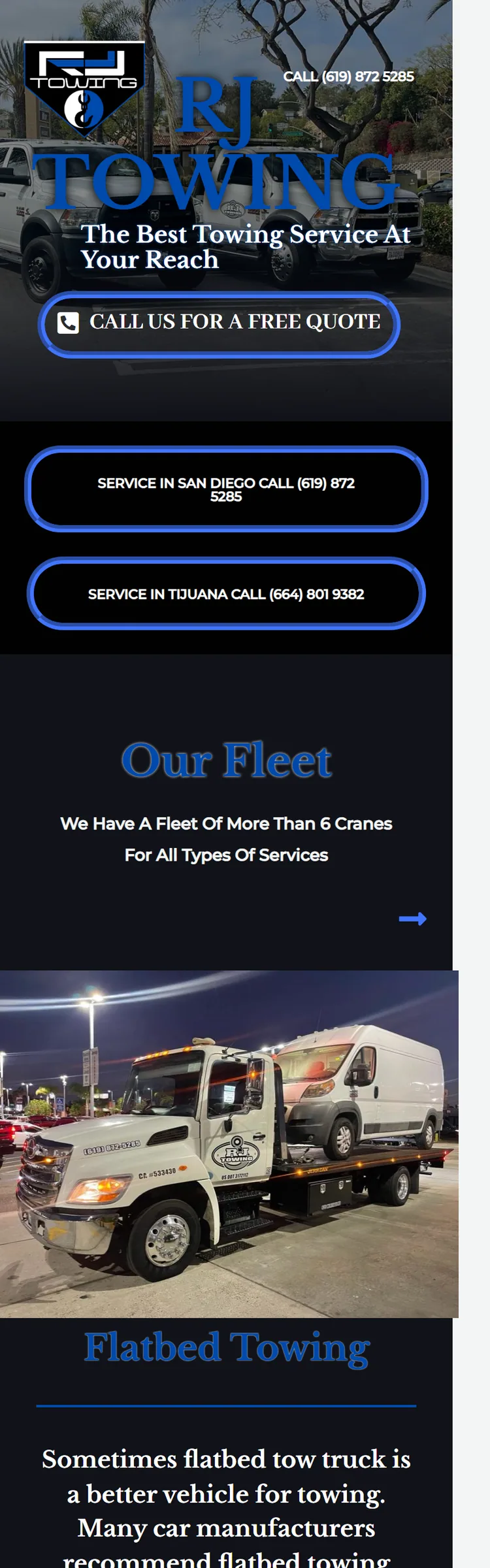
- 1 page, 459 words
- “Experienck” in the trust section
- Zero reviews displayed
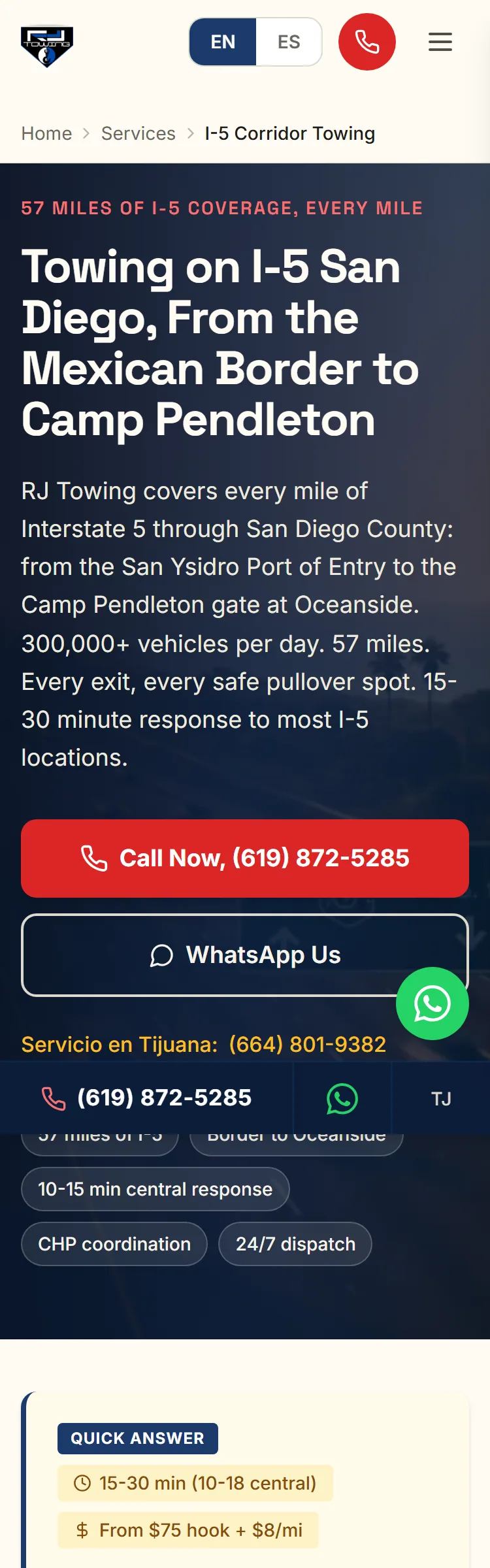
- No service pages, no neighborhood pages
- Google Ads traffic bouncing
- Lighthouse perf
- 59
- Largest paint
- 7.8s
- Page weight
- 4.86 MB
101 pages. 114/120 on a competitive benchmark. Delivered in one week. $2,500 to start, then $500 a month.
The problem
You pay Google $15 to $25 per click on towing ads. Someone searches “tow truck Phoenix,” clicks your ad, lands on your 5-page brochure site. No service page for their problem. No address. No reviews. They bounce back to search. You just paid for nothing.
About two-thirds of Google Ads clicks leave without calling. The worse the landing page, the higher that number. Google also charges you more per click when the page doesn't match the search. That's Quality Score, and most towing sites run it backwards.
Ranges are industry estimates. Your actual numbers depend on targeting and call center responsiveness.
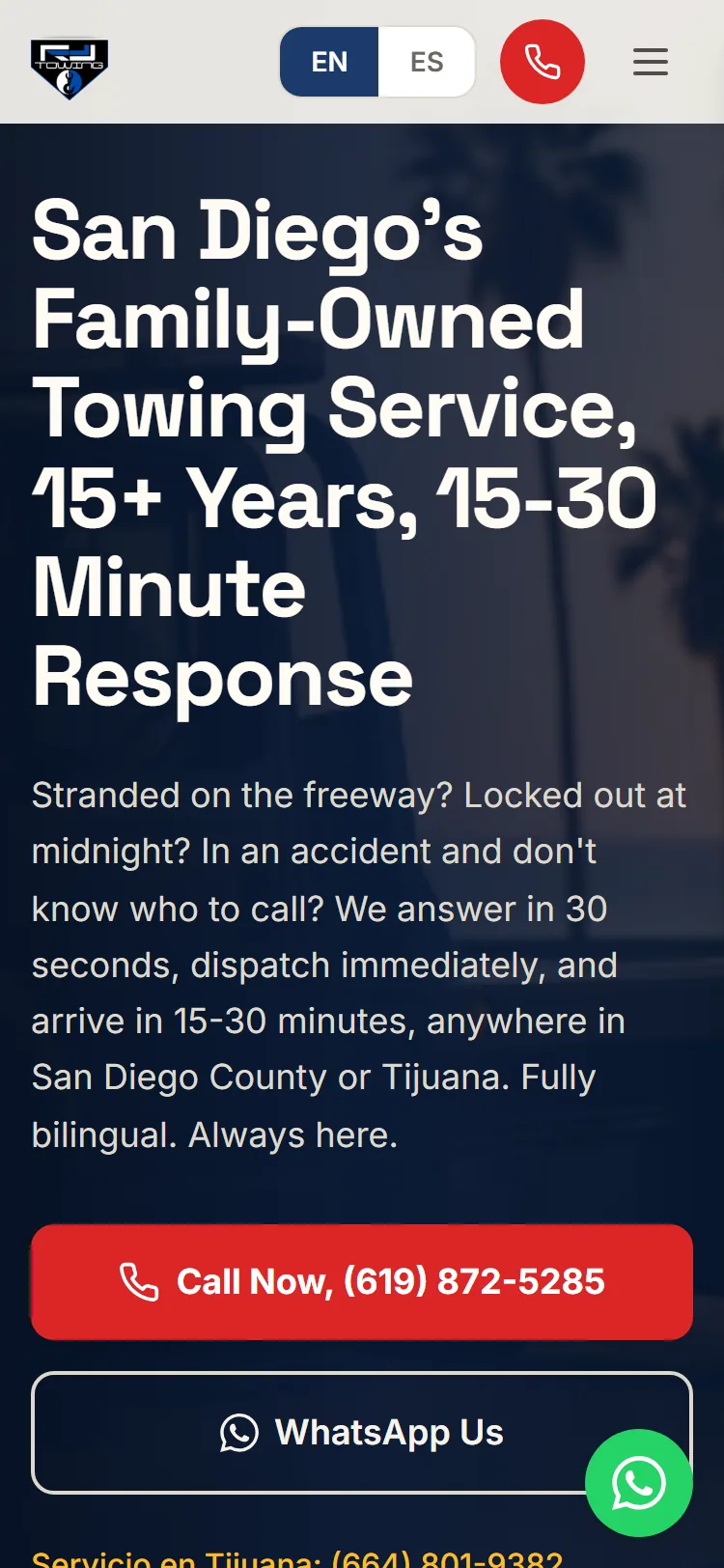
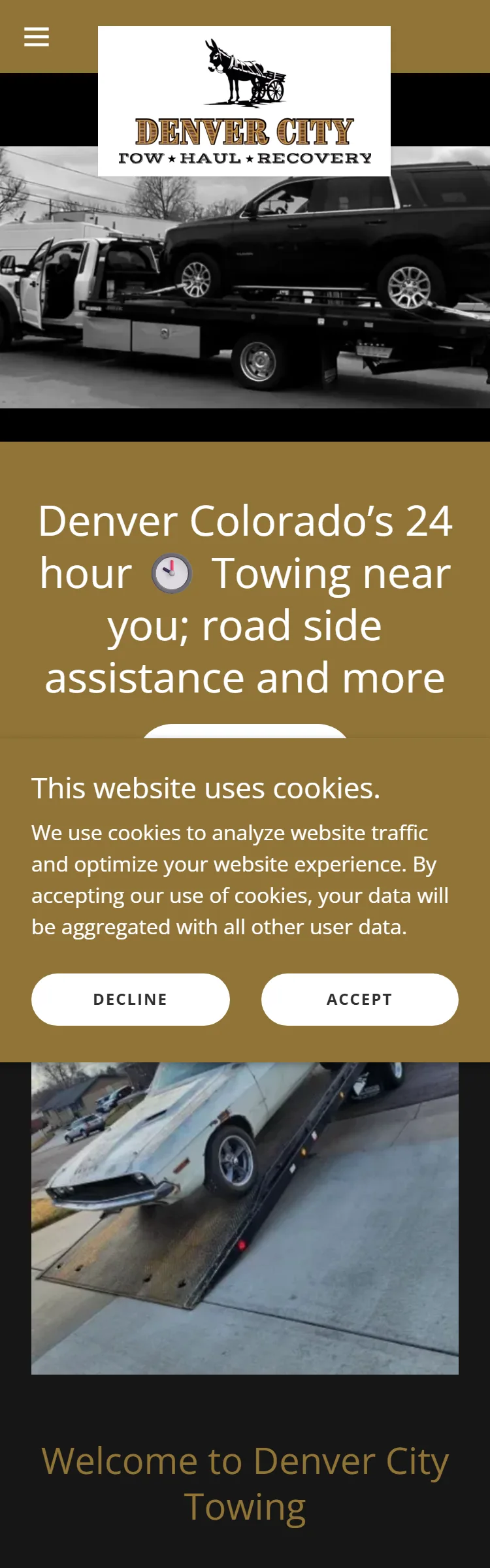
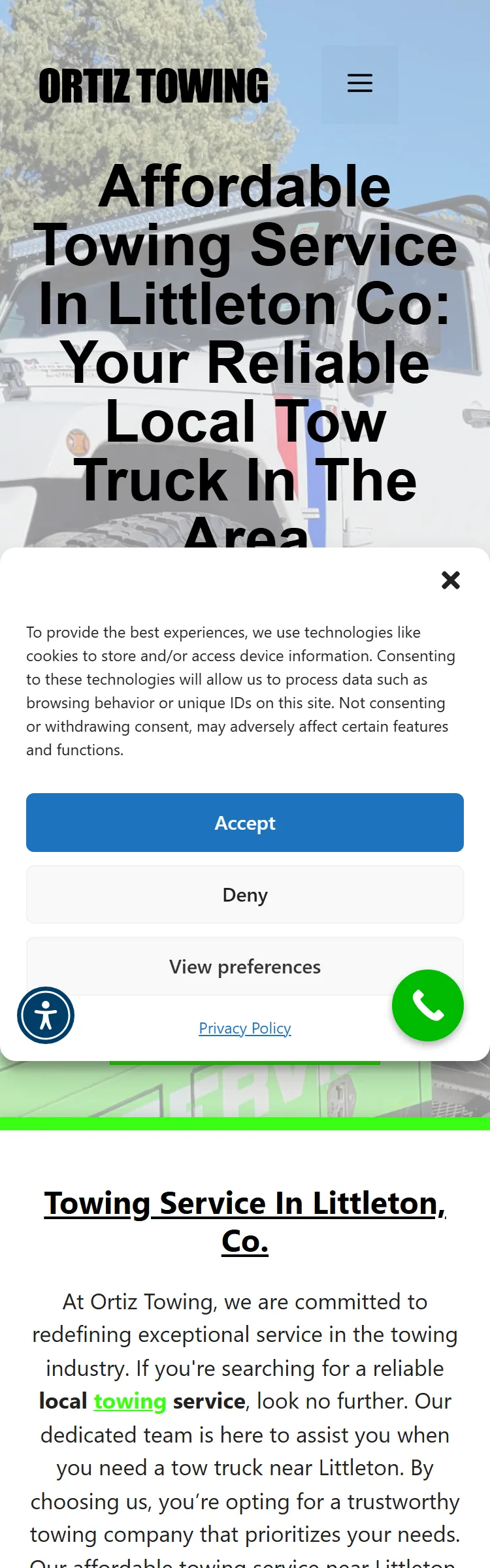
Same benchmark used on the RJ build. These are live sites running live ads today.
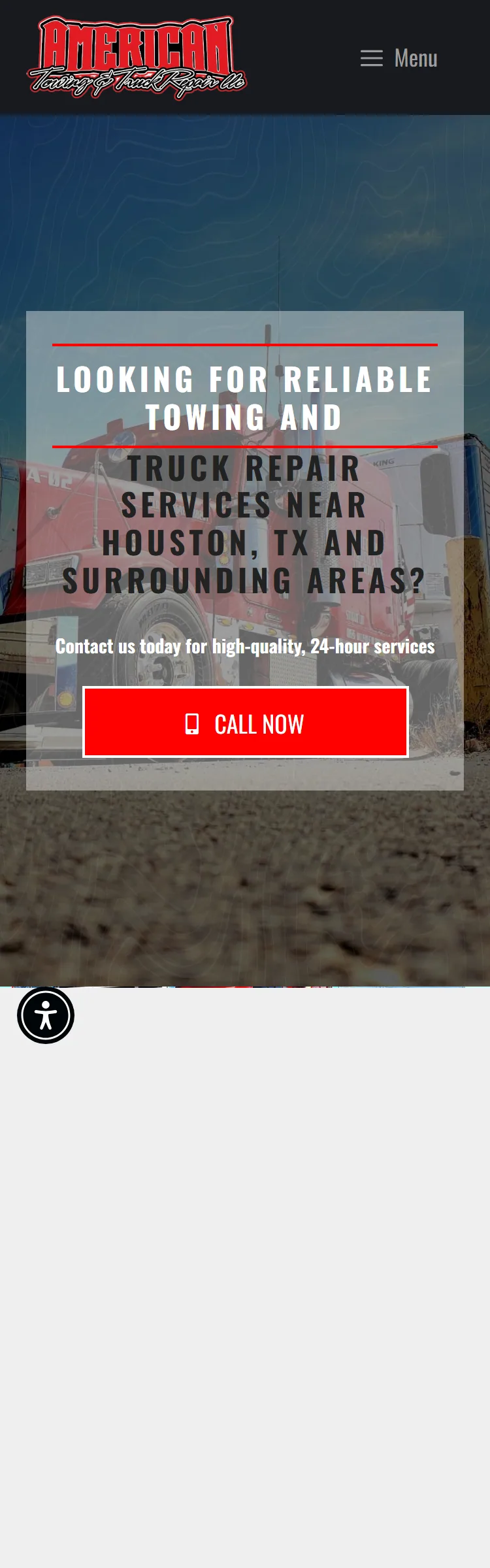
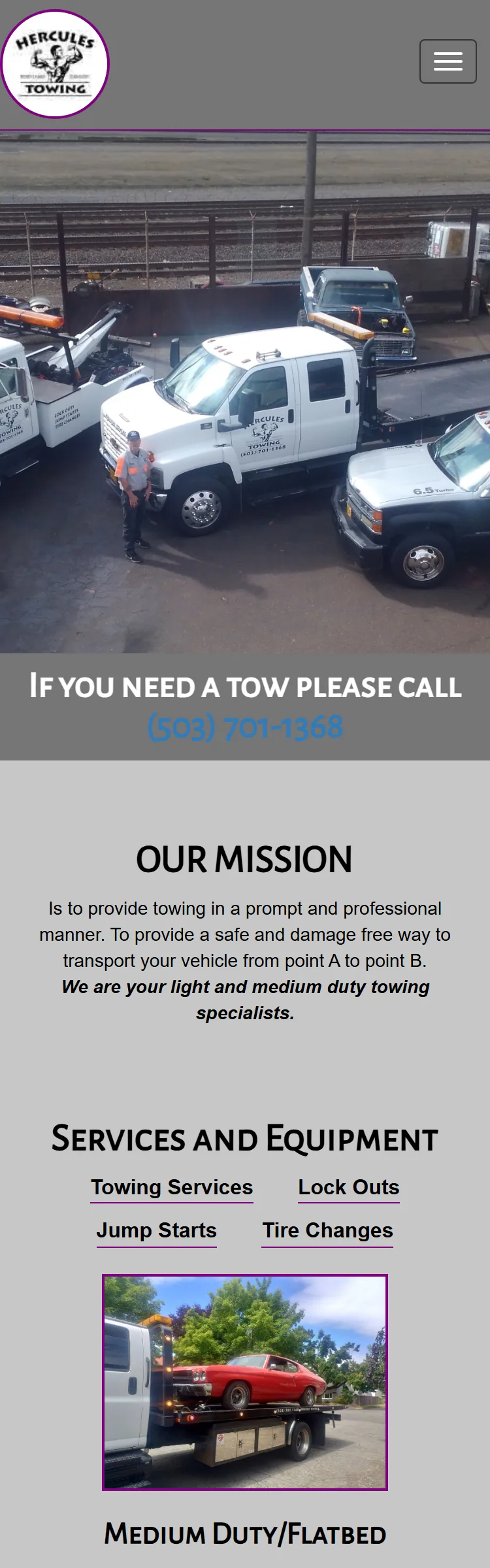
The transformation
My father-in-law's company. Real site. Real numbers. Still live. Old site had three typos, 459 words, and one page. New site has a partner portal, Spanish content, and more pages than any towing website in California.
Before
After
The numbers
What's included
Ten features on ten live pages. No upsell. No “contact us for the full list.” Every line item is in every build.
Every Google Ad points to a matching page. Quality Score rises. Cost per call drops.
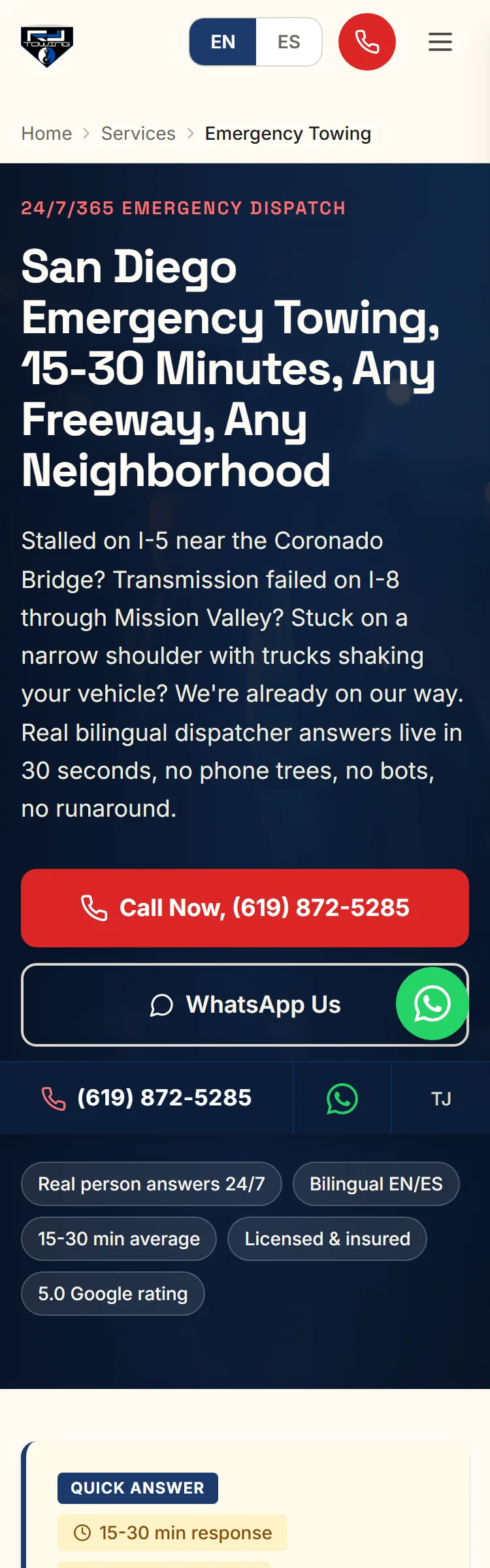
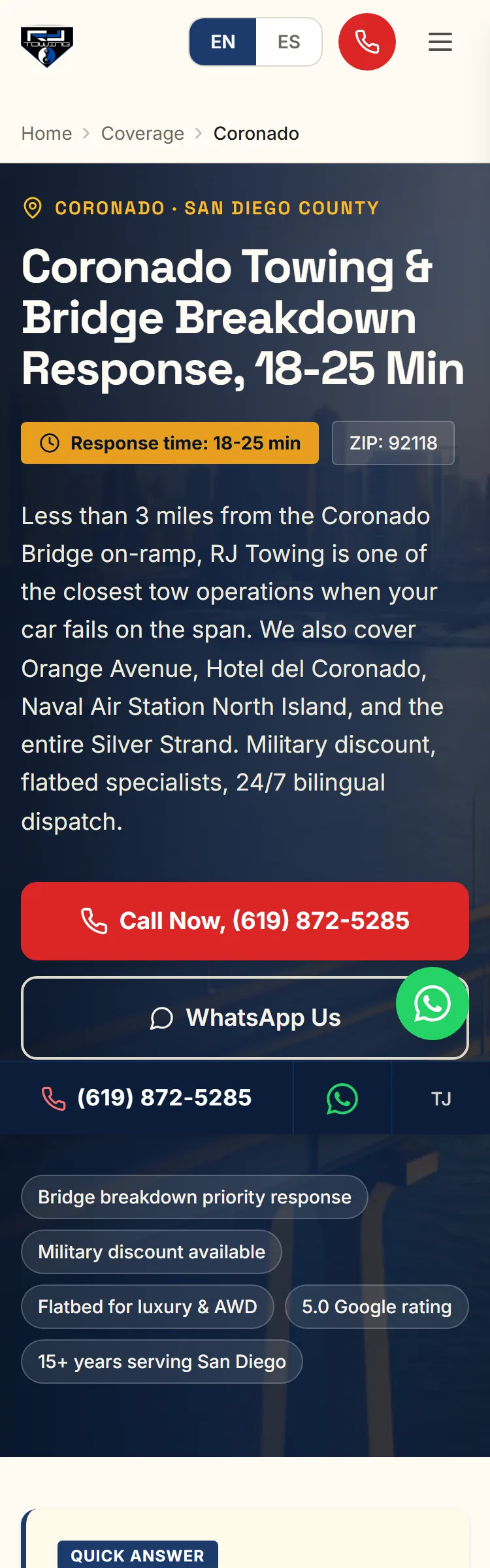
Real streets, landmarks, and ETA bands. Rank for every ‘[service] [neighborhood]’ search for the next three years.
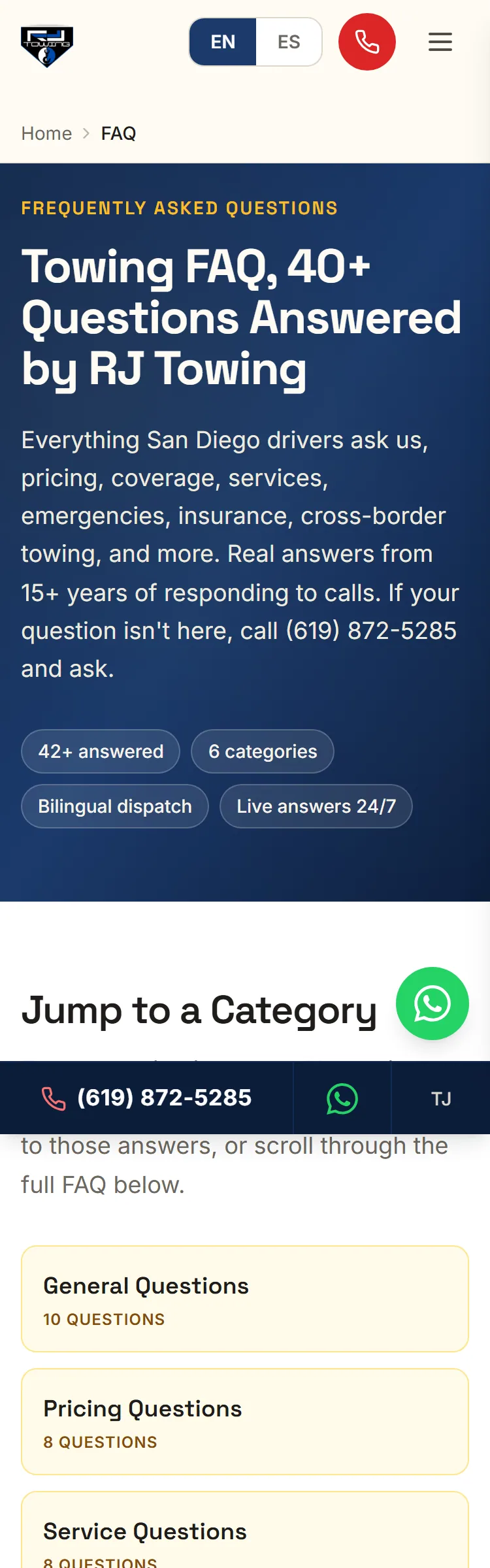
Body shops log in, request tows, download invoices. No competitor in most cities has one.
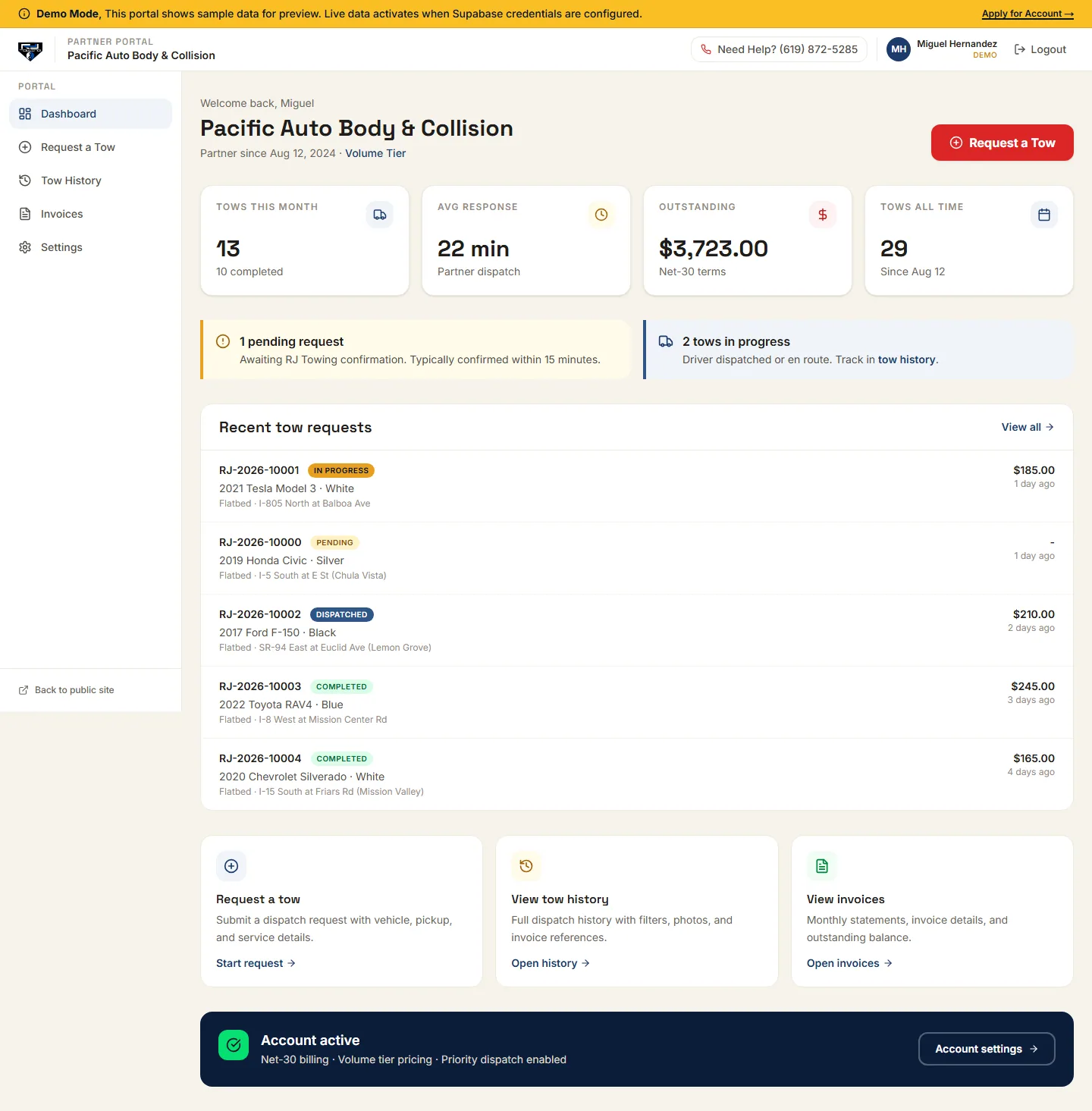
Real Spanish content. Not a language badge. Reach half the market your competitors ignore.
ChatGPT and Perplexity can read your site. The reference build earned an $850 referral its first month.
# llms.txt
Name: RJ Towing
Spec: AutomotiveBusiness
Services: /services/*
Areas: /coverage/*
---
{
  "@type": "AutomotiveBusiness",
  "name": "RJ Towing",
  "areaServed": [...]
}
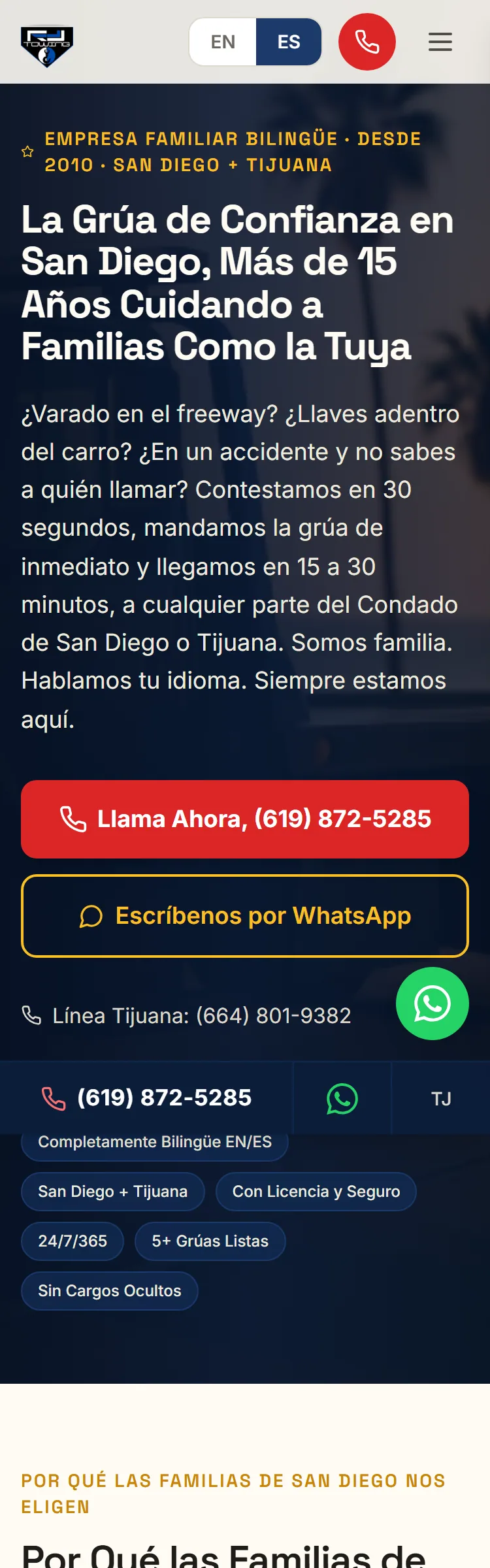
Live ratings and testimonials on the homepage. Every new review appears within 24 hours.
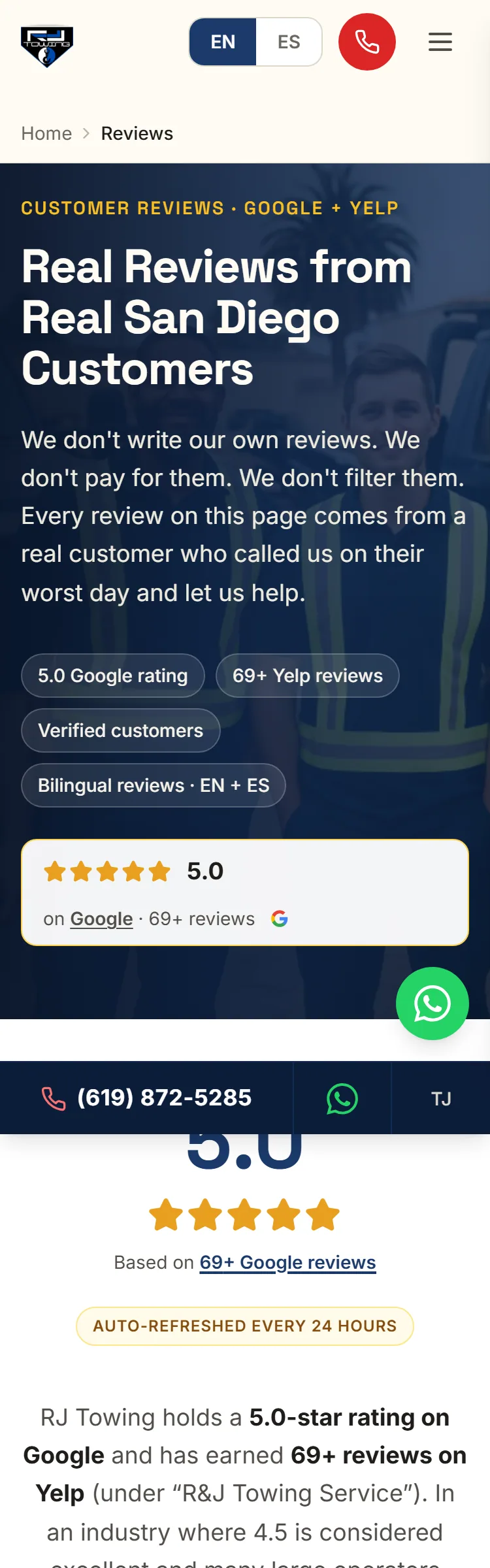
Plus 457 FAQ items sprinkled across the site. Google extracts these for featured snippets.
Structured data across every page. Google understands your business down to the service, review, and neighborhood.
# llms.txt
Name: RJ Towing
Spec: AutomotiveBusiness
Services: /services/*
Areas: /coverage/*
---
{
  "@type": "AutomotiveBusiness",
  "name": "RJ Towing",
  "areaServed": [...]
}10 posts live on day one. 4 new posts a month written for your city’s real search terms.
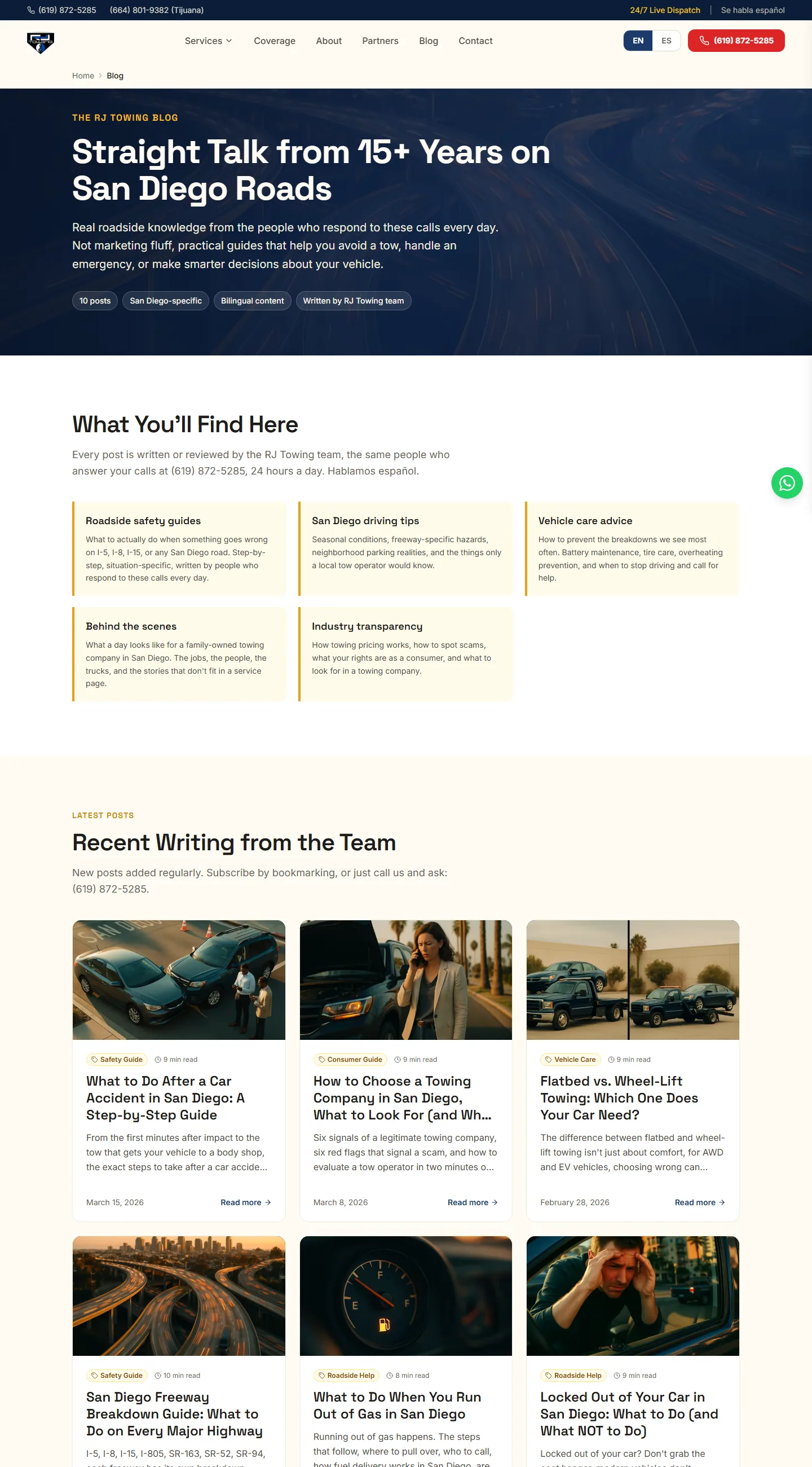
Exit-by-exit guides for I-5, I-10, or I-35. Catches every breakdown search your local competitors miss.
The money math
Google charges you less per click when the landing page matches the search. Quality Score rises. Cost per call drops. Every ad pointing to a matching service page means less money paid to Google and more calls routed to you.
Metric
Current site
After the rebuild
The yearly impact
$1,000/month ad budget. Roughly 24 extra calls a month. $150 per tow. Before organic traffic. Before AI referrals. Before partner revenue. Before Local Services Ads.
* Industry estimates, not audited client data. The $850 ChatGPT referral is real.
Local Services Ads
Your new site passes Google's quality check on day one. Your current one probably can't. Google Guaranteed ads pull 15 to 25% more clicks than regular ads.
Your turn
Enter your URL. Same 12-dimension, 120-point benchmark we used to score the RJ build, CloseBy, and 152 other US towing sites. Your numbers next to mine.
A second city, already built
We already built a 22-page demo for Phoenix. Real neighborhoods. Real freeways. Real ETAs. Deep Camelback, the I-10 stack, Scottsdale, Tempe, Chandler, Mesa. Monsoon season, snowbird season, Sky Harbor, Mill Avenue.
Why any of this is credible
01
The reference build earned an $850 tow job from a ChatGPT recommendation in its first month. The llms.txt file and 14 types of schema made the business visible to AI. Every build we ship includes both.
$850 · one month · one job
02
We scored 154 towing websites across 10 US cities on a 12-dimension framework before touching the RJ build. Average score: ~39/120. Best build we've shipped: 114. We know what good looks like because we measured what bad looks like first.
Phoenix · Las Vegas · Houston · DFW · Denver · Sacramento · Portland · San Antonio · Austin · Tampa
03
Not a WordPress template. A custom Next.js app on Vercel with server-rendered pages, edge caching, and a Lighthouse Performance score of 94. An agency build for the same scope takes 3 to 6 months and costs $15,000 to $50,000. We do it in a week for $2,500.
Next.js · Vercel · Tailwind · AI-generated imagery
Pricing, in full
Transparent numbers. No contact-us-for-pricing games. No hidden upsells. The full cost of working with me is right here.
Everything needed to launch a complete site.
The ongoing work that keeps you ranking.
Most sites hide this. Listing it upfront is how you avoid surprises in month 3.
Flat rate
12-month minimum
Questions? chris@towingsites.com
Common questions
5 to 7 days from the day you say go. We need one 30-minute call to capture pricing, services, fleet info, service areas, and any partner accounts. After that I handle everything. You review a staging site before it goes live.
Basics: business name, address, phone, hours, service list, and your ‘from’ prices. Team photos and bios if you have them. Your Google Reviews URL.
If you don't have photos, I generate imagery for launch. If you don't have blog post ideas, I write them using your city's search data.
Yes. The code, the content, the images, and the domain all belong to you. After 12 months you can migrate anywhere. Next.js sites run on Vercel, Netlify, AWS, or your own server.
Cancel any time. The site stays live as long as your domain and hosting are paid. Monthly deliverables (blog posts, review generation, performance reviews) stop. If you keep the plan, it renews month-to-month at the same $500.
Yes. The reference site is live at rjwebsite.vercel.app . 101 pages, partner portal, Spanish content, the whole build. Open it on your phone and scroll.
We replace it. Your old site goes down, the new site launches on your domain the same day.
If there's content worth saving (reviews, team bios, specific service copy), we pull it forward. Most old towing sites have 3 to 5 pages of content. Those get rewritten and expanded into the 101-page structure.
Hosting. 4 blog posts. Monthly Google Ads performance review. Review generation system. Site updates as needed. Priority email and text support. Quarterly competitive re-score on the same 12-dimension benchmark.
Agencies staff the build with designers, copywriters, developers, and project managers. I use Claude Code and GPT image generation, operate solo, and ship in one week instead of three months.
Actual delivery cost is about $4 in OpenAI credits and a day of my time. The rest is margin. I'd rather price for 10 clients a month than 10 a year.
Yes. RJ Towing's owner is my father-in-law. You can reach him through me and I'll hand off contact directly. More clients are onboarding in April and May. I'll connect you once they're live.
The staging site is your checkpoint. If it's not right, we iterate before launch. No clock running, no extra fee. If we can't get it there, you walk without paying the monthly. That hasn't happened yet, and the model works because the benchmark is objective: if your score doesn't clear 100/120 on launch day, something is wrong.
Ready?
Two ways to start. Score your site and see the gap, or book a 15-minute call and we walk through it together.
Building towing websites one week at a time.